


Come for the economics, stay for the books and the links that earned a bookmark (favorite books of 2025 and my favorite finance books).
Get in—we are talking about the newest arms race hype in the ultra-rich wealth management scene, and what is coming to retail customers.
A recent paper by Federico Mainardi, an assistant professor at Columbia Business School, found that compared to less wealthy households, the richest Americans realize a smaller fraction of gains but more losses, especially if they use a private bank. He estimates that without such tax alpha, the share of wealth held by the top 1% would grow by 3.5 percentage points less over 30 years.
Perceivably, the investing world is changing. It’s morphing from picking better stocks and beating the market to winning your tax bill.
Quick History Lesson
Back in the dark ages, before low-cost index funds swallowed the investing world, you paid an advisor to pick stocks, rotate sectors, and try to outperform the market.
Then the evidence rolled in. The vast majority of active manager fail to beat their benchmarks. Sometimes, in the short run (highlighted in orange), they can beat the benchmark, but, as you can see in red, over the long term, close to 90% fail!
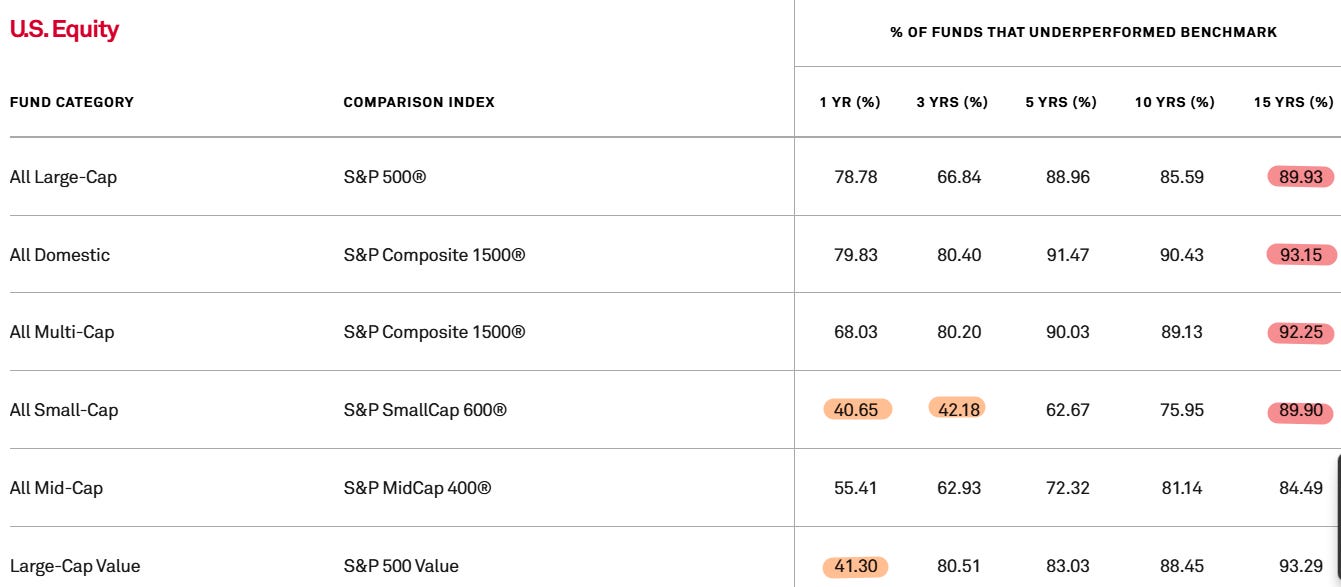
There are exceptions, of course, but as a general rule, trying to outperform the S&P 500 has not worked well for the average investor. There are legends like Warren Buffett, but even there, most of the famous outperformance came long ago, in a much less efficient market.
So the old promise of public-market alpha got weaker. And when the old promise weakens, Wall Street goes looking for a new one—enter Tax Alpha.1
Tax Alpha
Tax alpha is the idea that even if you cannot beat the market on a pre-tax basis, you may still improve an investor’s after-tax outcome through smarter tax management.
The cleanest example is direct indexing.
If you own the S&P 500 through an ETF and the fund drops, you can sell it, realize a loss, and use that loss for tax purposes. But then the wash sale rule gets in the way if you buy back the same security too quickly.
Direct indexing changes the setup. Instead of owning one fund, you own many of the underlying stocks directly. That gives the manager more opportunities to harvest losses stock by stock while still roughly tracking the index. One company may be down even when the overall portfolio is fine. Sell the losing stock, capture the loss, and keep the portfolio moving.
That is the basic appeal: same general market exposure, more tax flexibility.
And once you understand that, the rest of the industry starts to make sense.
Direct Indexing to More Complex
Directing indexing is the beginning of more opaque strategies.
For example, some strategies add long-short exposures, arguing that short positions create even more opportunities to generate losses. Others use separately managed accounts to customize tax lots with greater precision.
Bloomberg recently highlighted just how large this world has become. By September 2025, direct indexing alone had reached roughly $1.1 trillion, according to Cerulli. More broadly, investors put more than $1 trillion into a range of tax-optimization strategies, including SMAs, ETFs, and hedge-fund-like structures, and other vehicles.2
That growth is not an accident. It is the natural next step in a world where low-cost beta is cheap, widely available, and hard to improve upon. Once investment fees compress and market returns become commoditized, the next frontier is taxes.
Other, more advanced strategies go long and short (betting on companies to rise or fall). These strategies argue that going short offers more opportunities for tax alpha.
Below is an overview of the newer strategies Wall Street is pushing:
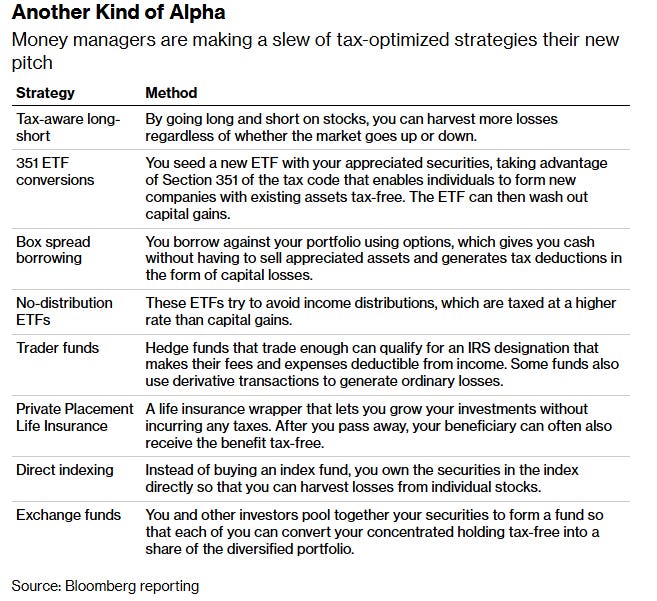
Technology is pushing the entry level of these strategies lower. Looking at Exchange Funds, where if you have a highly appreciated stock, you contribute it to the fund, and receive a basket of securities in return. Effectively trading your concentrated stock position for a more diversified portfolio (an investment manager’s dream!).
Previously, you needed a $5m asset to gain entry. Now, technology like Cache has lowered the minimum position size to $100k!
Firms like Alpha Architect are aiming to lead in this area. They’re focusing on 351 conversions, which can turn appreciated securities into an ETF structure and potentially allow rebalancing without immediate tax recognition. Also, they have strategies like BOXX, which aims to deliver short-term Treasury-like returns with a more favorable tax profile.
Welcome to Wall Street’s pattern over and over again: old tax rules plus modern engineering equals a new product category.
The details differ, but the logic stays the same. Find legal asymmetries in the tax code, wrap them in a slick structure, and sell them as smarter portfolio management.
Tax law may be catching up. 3
Of course, these strategies do not exist in a vacuum.
Many of these strategies rely on decades-old provisions written for a very different era. The tax code did not anticipate today’s trading speeds, product complexity, or engineering talent. What began as narrow administrative or business-formation rules can now support an entire ecosystem of sophisticated tax products.
That has started to attract attention. From Senator Wyden (who is on the Finance Committee):
“Congress has passed a lot of tax policies to encourage things like retirement savings and affordable life insurance for typical families, but it never intended for tax dodging to become a core investment strategy for the ultra-wealthy,” Wyden says by email. “Congress hasn’t done nearly enough to keep up with loophole-pioneering tax lawyers and accountants.”
Bloomberg reported that the Treasury is discussing greater scrutiny of 351 conversions, potentially including more disclosure requirements to the IRS. Senator Ron Wyden has also proposed legislation to limit the tax benefits of exchange funds and 351 conversions, though the odds of major reform in the near term still look low.
Still, the direction is clear: the more these strategies scale, the more likely they are to attract regulatory heat.
And that brings us to the most important point for investors.
The downside
None of this is free.
These strategies often come with higher fees, greater complexity, greater tracking error (you no longer get the index performance you started with), greater operational risk, and, in some cases, greater leverage. They also rely on tax interpretations that may hold up for years, only to suddenly no longer do.
That is the real risk with financial engineering. It can work beautifully right up until the day someone important decides it should not.
There is also a more practical issue: much of the tax alpha is really tax deferral, not tax elimination. That distinction matters. Deferral can be enormously valuable, but it is still different from magic. Eventually, many investors will owe taxes when they liquidate positions, unwind structures, or exit the strategy.
And because unrealized gains build over time, these products can become handcuffs. The strategy may be working, but it's leaving you locked into an expensive account!
That is part of why the business is so attractive to managers.
Why this may move down-market
What starts in private banking rarely stays there forever.
That is probably the most interesting part of this trend.
Bloomberg framed tax-aware investing as a kind of “Boglehead 2.0,” and that feels directionally right. First came low-cost indexing. Now comes tax-aware indexing. Family offices and private-bank clients once had this to themselves, but firms are now slowly productizing it for smaller accounts.
The minimums are falling. The software is getting better. Personalization is becoming easier to deliver.
So while today’s most aggressive strategies still live mostly in the ultra-rich corner of the market, the broader idea is likely coming for retail investors too: not just own the market cheaply, but own it in the most tax-efficient way possible.
That will sound smart, and sometimes it will be. But investors should understand what they are buying. Some of this is common-sense tax management. Some of it is complicated legal engineering with elegant marketing.
Those are not the same thing.
The bigger takeaway
The wealth-management industry did not stop searching for alpha. It just changed the definition.
For years, the dream was stock-picking alpha. Now the dream is after-tax alpha.
That shift makes sense. Markets are brutally competitive. Taxes are messy, fragmented, and full of edge cases. One is hard to beat. The other is full of opportunity for anyone with enough lawyers, quants, and product specialists.
That is great news for sophisticated investors who understand the tradeoffs.
It is also a reminder that when Wall Street tells you it has found a better way to invest, the first question is still the right one:
Better for whom?
Keep Reading
What does the stock market do on average?
TL: DR—Markets go up over time, but rarely in a straight line. Double-digit pullbacks are normal, bigger selloffs happen every few years, and the lesson for investors is to expect volatility and embrace (or don’t invest in stocks).
Curious about Rare Earth Metals?
TL: DR—Rare earths are abundant, but the ability to refine them is scarce. China owns that choke point; that exposure leaves the U.S. vulnerable, and tariffs do not solve the deeper supply-chain problem.
Looking to travel? Check out Paris and Tuscany
Are you panicking about the impending economic calamity?! Check my Millennial Guide for Surviving Continued Once-In-A-Lifetime economic events.
Here are some of my recent favorite books with overviews: Apple in China, How to Make a Few Billion Dollars, and Breakneck: China’s Quest to Engineer the Future.
Looking to hire a financial advisor? Ask them these questions.
DISCLOSURE
The information presented is solely for educational purposes. The information, statements, comments, views, and opinions expressed in this podcast and newsletter do not constitute and should not be construed as an offer to buy or sell securities or make or consider any investment or course of action. The views or opinions expressed in the podcast and newsletter are the author’s views and do not reflect the opinions and beliefs of the podcast and newsletter, its affiliates, the author’s employer, or any other person. The podcast and newsletter do not undertake any duty to publicly or otherwise update or revise any disseminated information.
Tax Disclaimer: I am not a tax advisor, and nothing here should be taken as tax advice. Everyone’s tax situation is different, so please talk with your CPA or tax professional before making any decisions.
Tax Disclaimer: I am not a tax advisor, and nothing here should be taken as tax advice. Everyone’s tax situation is different, so please talk with your CPA or tax professional before making any decisions.